The real STEM camps.
A typical STEM camp week in the US runs about $550. Most families end up paying somewhere between $340 and $924 — the range covers rec-department tech days on the low end and university-affiliated intensives on the high end. Numbers here come from 1,429 camps that published their 2026 prices.
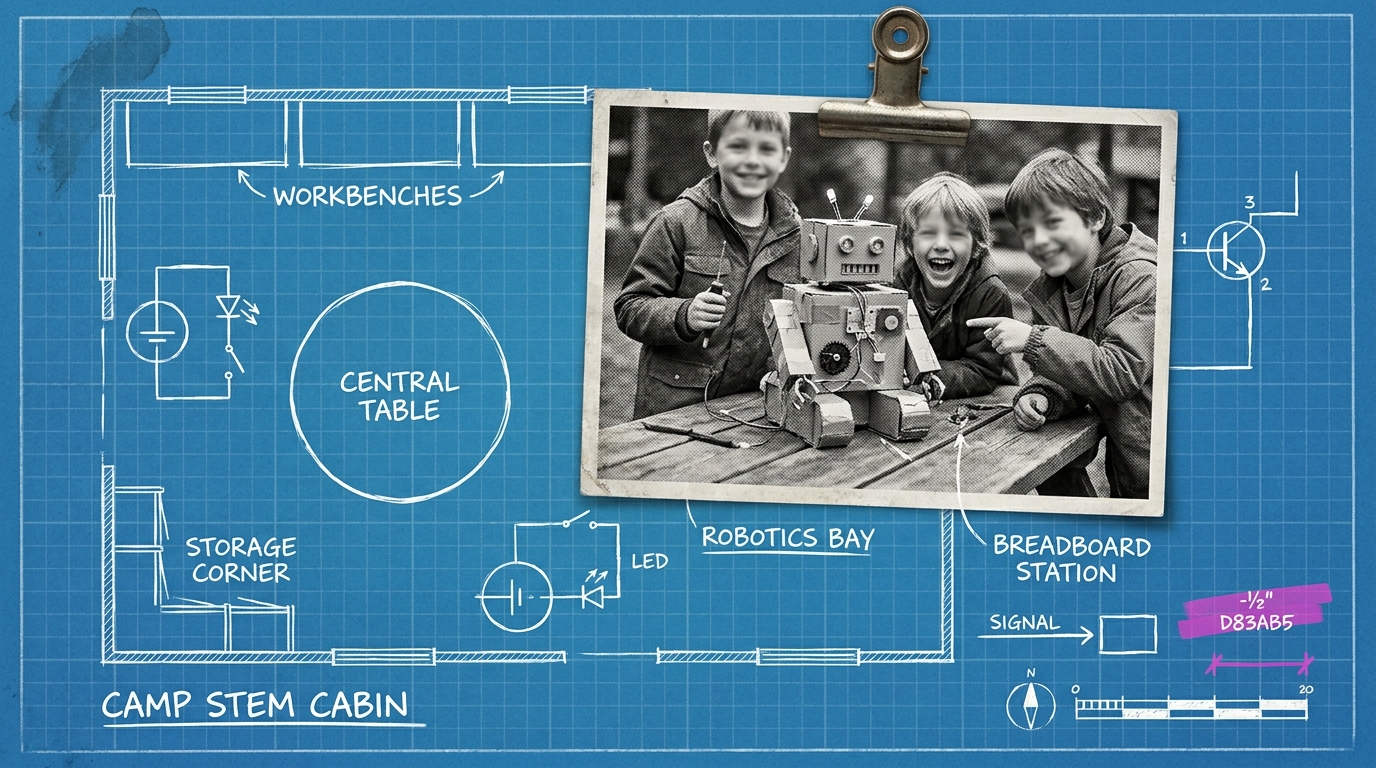

A real STEM camp has a week-by-week curriculum, instructors who know their subject, and something the kid built that you can actually look at on Friday. A fake STEM camp has a beautiful website, supervised screen time, and the word "STEM" in its ads. At around $550 a week, you're paying for the curriculum — make sure one exists.
- Match the format to the age. Legos and ramps for 4–6, visual coding intros for 7–9, real programming for 10–12, advanced tracks for 13 and up.
- Ask what the kids build each week. If the camp can't answer in specifics, there's no curriculum to protect.
- Small cohorts beat fancy spaces. Twelve kids with a great coach will out-learn twenty-five kids in a prestigious building.
- University-branded doesn't always mean university-taught. Ask who teaches and who operates as two separate questions.
- A Friday showcase or portfolio tells you the program was teaching toward something all week.
STEM looks different at 5 than it does at 15.
Ages 4–6: keep it off-screen
STEM at this age is physical. Simple machines, Legos, kinetic sand with gears, ramps, water play, nature journals. Programs that put iPads in front of four-year-olds and call it "preschool coding" are almost always weak — a kid who loves blocks will learn more from three hours of structured building than half an hour of Scratch Jr. Galileo's Camp Kaleidoscope, Mad Science, and Little Partners are good places to start looking.
Ages 7–9: the first coding intros
Scratch (MIT's drag-and-drop language), Minecraft: Education Edition with redstone and command blocks, LEGO WeDo or early Spike Prime, a micro:bit for simple physical computing. The goal here is pattern recognition and cause-and-effect logic — not production code. The better camps at this age show you what the kid made on Friday and can walk you through the progression from Monday to Friday.
Ages 10–12: real programming starts to land
Python fundamentals, JavaScript basics, Roblox game development, Minecraft modding in Java or Python, intermediate robotics on Spike Prime or VEX IQ. Kids at this age can handle typed code in small doses and love finishing something they can show off. iD Tech, Coder School, and VEX Robotics Camps all run good programs at this level. Watch for over-promising — "build a mobile app in five days" usually means "fill in the blanks of a template app."
Ages 13–17: advanced tracks and college signal
Web and app development, AI and machine-learning intros, competitive robotics (FIRST, VEX), pre-college labs at universities (Stanford Pre-Collegiate, MIT Launch, Berkeley's ATDP), and genuinely competitive research programs (SSP, RSI). For teens who want to apply to selective STEM programs, a research-style summer beats a slick branded intensive nearly every time — admissions readers can tell the difference.
2026 STEM camp pricing in the US
Drawn from 1,429 STEM camps that published 2026 prices. Real STEM sits well above the general day-camp average (around $150 a week) because subject-matter instructors and small cohorts cost money. If a program is priced like a generic day camp, at $340 or below, treat it as one until proven otherwise. A program at $1,149 or above should offer something you can clearly point at — recognized instructors, specialized equipment, or a portfolio outcome that means something.
STEM pricing in the biggest metros
| Metro | Camps | Budget end | Typical week | Premium |
|---|---|---|---|---|
| Los Angeles | 505 | $495 | $595 | $899 |
| Atlanta | 33 | $550 | $550 | $949 |
| Palo Alto | 26 | $949 | $949 | $1,149 |
| Pittsburgh | 24 | $510 | $949 | $949 |
| Houston | 22 | $500 | $949 | $949 |
| New York | 21 | $949 | $949 | $949 |
| Cambridge | 19 | $949 | $949 | $949 |
| Seattle | 18 | $949 | $949 | $949 |
| Sherman Oaks | 17 | $775 | $775 | $775 |
| Pasadena | 16 | $1,049 | $1,049 | $1,049 |
| Evanston | 16 | $949 | $949 | $949 |
| Denver | 14 | $949 | $949 | $949 |
Linked metros go to the strongest public directory page available for that city.
What tells you it's teaching, not just tech-themed day care.
- Learning goals written down, week by week. "On day three, campers learn conditionals and build an interactive story." Not "campers will explore coding."
- Named lead instructors with real backgrounds. A CS degree, a STEM teaching credential, or three-plus years of relevant industry work. Junior counselors support the lead; they don't run the room.
- Cohorts split by age. A 6-to-14 mix is free play with tools. Eight-to-tens and eleven-to-thirteens in separate rooms is real instruction.
- Something the kid built each week. A robot, a published game, a wired circuit, a printed model. Not a worksheet.
- A cohort size you could actually teach. Ten to fifteen for serious programs. Over twenty and the kids are mostly self-directed — which is fine for a maker space, not fine at $600 a week.
- A Friday showcase or portfolio. Programs that are confident in what they taught will show you what the kids made. Programs that aren't, won't.
Questions other parents asked
What actually counts as a STEM camp?
A STEM camp spends most of its instructional hours on science, technology, engineering, or math — with a real curriculum, instructors who know the subject, and something the kid can show for it at the end of the week. Programs like iD Tech, Galileo, Engineering For Kids, Coder Kids, and Destination Science fit. A day camp with a Tuesday 'tech hour' does not, no matter what the website says. The clearest test: ask the camp what your kid will learn Monday through Friday. If they can't describe it, there's no curriculum to describe.
How much do STEM camps cost?
A typical week runs around $550. Most families pay between $340 and $924. That's well above the general day-camp average (around $150 a week), and the gap is the whole point — STEM costs more because real subject-matter instructors and small cohorts cost more. If a program is priced like a standard day camp, it's probably a standard day camp with a tech sticker. Real specialty STEM starts around $400 and climbs from there.
What's the right starting age?
Ages 4–6 should stay mostly screen-free: Legos, simple machines, ramps, water play, anything physical. Skip the preschool coding camps — a five-year-old who loves blocks will get more out of three hours of structured building than half an hour on Scratch Jr. Ages 7–9 are a good moment for visual coding intros (Scratch, Minecraft: Education Edition) and LEGO robotics. Ages 10–12 can start writing real typed code — Python, JavaScript, Roblox game development, intermediate robotics. Ages 13 and up are ready for advanced tracks: web and app development, AI and machine-learning intros, competitive robotics, and university-style research programs.
Minecraft camp — is it just playing games?
Depends entirely on the camp. A good Minecraft program uses the game as a teaching canvas: redstone circuits as a hands-on intro to logic gates, command blocks as a real programming surface, modding in Java or Python, collaborative world-building that stretches into systems thinking. A bad Minecraft camp is supervised free-play with a premium price tag. Ask exactly what the kids will build across the week and what the instructor will teach them to do. The answer should be specific, not vague.
What curriculum signals should I look for?
Six things separate a real curriculum from a STEM sticker. First, week-by-week learning goals you can actually read: 'on day three, campers learn conditionals and build an interactive story' — not 'campers will explore coding.' Second, named lead instructors with relevant backgrounds (a CS degree, a teaching credential, or a few years of industry work). Third, cohorts split by age, not one 6–14 blob. Fourth, something the kid built each week — a robot, a game, a wired circuit. Not a worksheet. Fifth, cohort size capped around 10 to 15 for serious programs. Sixth, an end-of-week showcase or portfolio. When most of these are missing, the curriculum probably is too.
Are the expensive STEM camps actually worth it?
Sometimes. A $1,500-a-week program should give you at least one of: a genuinely recognized lead instructor, hardware and software your kid can't get at home (3D printers, VR labs, actual wet labs), industry-standard tooling, an outcome that means something for college or competition, or small-group coaching. If the $1,500 camp is just a slick website and a nice building, you're paying for the brand. Compare against what a typical week runs in your metro — a big premium should come with a big reason.
Stanford, MIT, Berkeley camps — worth the premium?
The university name usually adds $300–$500 a week over a comparable non-branded program. You get campus facilities, occasional guest talks, and a line for the college app. What you often don't get is the university's actual faculty teaching the camp. Most university-branded programs are run by third-party operators who license the location for the summer. Ask two separate questions: who teaches, and who operates? A straight answer tells you whether you're paying for instruction or for the logo.
Coding, robotics, or general STEM — how do I pick?
Coding camps (Scratch, Python, web development) are the biggest slice of the STEM world and tend to fit kids who are already comfortable on a computer at home. Robotics (LEGO, VEX, FIRST) is better for kids who learn with their hands — there's a real thing in front of them that either works or doesn't. General STEM programs (Galileo, Destination Science) rotate through topics and suit kids who don't know yet what they love. Bio and chem camps are rarer and usually live at universities. Pick based on what your kid is already curious about, not what you wish they were.
Where the numbers come from. Price ranges pull from published 2026 camp rates across STEM, STEM/Tech, STEM/STEAM, Science/Tech, Arts/Tech, and Science/Museum categories. The curriculum-quality framework is synthesized from conversations with camp directors and from reading the published curricula of iD Tech, Galileo, Destination Science, FIRST Robotics, and a handful of university-affiliated programs.
Scope. STEM-labeled day and overnight camps for ages 4 to 17, across the US and Canada.
Bias note. Written by a parent, reviewed by our editor. Not a computer-science-curriculum specialist. The framework reflects the quality signals we've seen correlate with strong outcomes across 2024 and 2025 seasons — your kid is the only benchmark that finally matters.
Last reviewed. 2026-04-18.
Related guides
- 2026 camp pricing, by category and city
- How to choose a summer camp — the general framework
- Safety and ACA accreditation
- STEM camps in Los Angeles
- STEM camps in the San Francisco Bay Area
- STEM camps in New York City
- Open the planner — line up STEM weeks across the summer
Build your kid's STEM summer.
The planner filters to STEM camps in your city — robotics, coding, engineering, design. Drop weeks, see the schedule form.
Open STEM camps →