Summer camp safety.
What the ACA accreditation label really buys you, ten questions any camp should be able to answer without flinching, and six red flags that should end the tour.
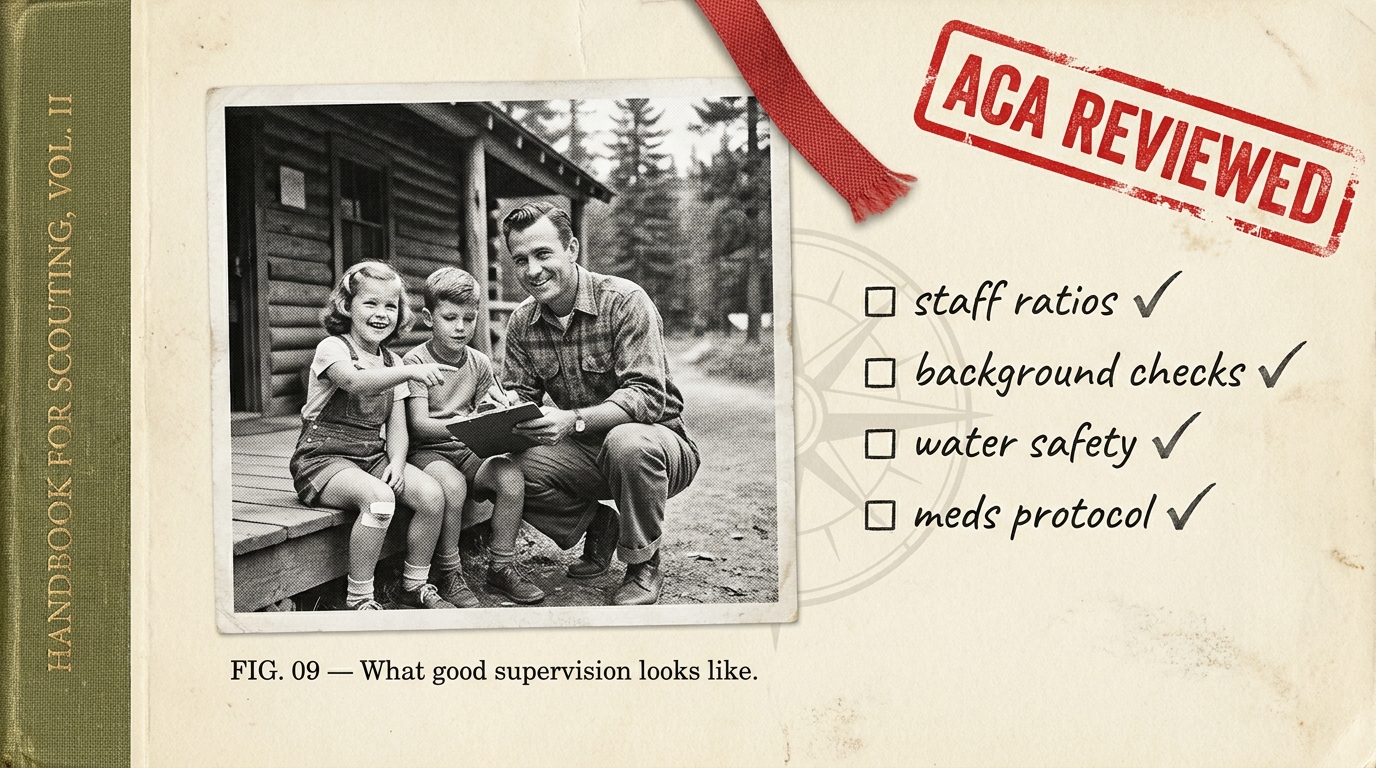
A safe camp has real answers to specific questions, a published background-check policy, and staff ratios at or better than the ACA's guidelines (1:6 for ages 4–5, 1:8 for 6–8, 1:10 for 9–14). ACA accreditation is a strong positive signal, but it's not required by law — only about 2,400 of roughly 12,000 US camps have it. A camp without the badge that answers safety questions clearly beats an accredited camp that treats the badge as the finish line.
- ACA reviews about 300 standards covering staff training, ratios, health care, emergency plans, food safety, and program design.
- Staff retention is the best single tell of a camp's health. 60% or more returning year-over-year is strong; below 40% is turnover you should ask about.
- Ratios get tighter around water and younger kids. Expect 1:1 for non-swimmers and 1:6 or better for the littlest campers.
- Ask for two parent references from last summer. Good camps share them without hesitation.
- Evasiveness is the real red flag. If a camp waves off medication questions or can't describe an emergency plan, keep looking.
The ~300 standards behind the badge.
The American Camp Association accreditation is a voluntary, third-party evaluation against roughly 300 written standards. A camp that pursues it pays an annual fee, hosts an on-site visit every 5 years, and must meet the standards to earn and keep the badge. Standards are grouped into six domains:
- Site + Food Service. Facility safety, sanitation, food storage, allergen handling.
- Transportation. Vehicle maintenance, driver qualifications, supervision during transit.
- Human Resources. Background checks, staff training, supervisor-to-counselor ratios, staff files.
- Health + Wellness. Medication handling, on-site health care, illness and injury protocols, emergency plans.
- Operational Management. Safety committee, incident reporting, camper supervision, emergency preparedness.
- Program Design. Age-appropriate activities, aquatics safety, high-risk activity supervision (climbing, horseback, archery).
What ACA doesn't evaluate: program quality (is the STEM curriculum good?), individual staff warmth, camp culture, how a camp specifically handles your kid's needs. Accreditation is a floor, not a ceiling.
ACA accredited vs. state licensed vs. neither.
Three labels parents see on camp websites and what they actually mean. Most US camps fall in the right-hand column.
| What it covers | ACA accredited | State licensed (most states) | Unaccredited + unlicensed |
|---|---|---|---|
| Required by law? | No (voluntary) | Yes (where the state has a camp statute) | N/A — exempt or no state regime |
| Standards count | ~300 across 6 domains | Varies (food, water, ratios, often fewer than ACA) | Local fire-and-life-safety only |
| On-site review cadence | Every 5 years | Annual permit; some states inspect | None unless complaint-driven |
| Background checks required | Yes — annual for all staff | Most states yes; some only directors | Up to the operator |
| Staff-to-camper ratio rule | Set per age group (1:6 / 1:8 / 1:10) | Set, often looser than ACA | No required floor |
| Approximate US camp count (2026) | ~2,400 | ~6,500 (varies by state regime) | ~3,000 (church, school, exempt) |
| Best parent question | Show me your most-recent ACA report | Show me your current state permit | Walk me through your safety policies in writing |
Camp counts are editorial estimates from state databases plus the ACA accreditation list (April 2026). State licensing varies materially — see the per-state regulation note on each state directory hub for the relevant statute.
Ten safety questions to ask every camp.
Every camp has a polished website. What separates good camps from average camps is how fluently they answer concrete safety questions. Email or call with the following. Note which camps answer specifically (they've thought about it), which hand-wave, and which get defensive.
- What's your staff-to-camper ratio for my child's age group? Target: 1:6 for ages 4–5, 1:8 for 6–8, 1:10 for 9–14. Overnight camps should beat these by 1–2.
- What's your background-check policy? Annual fingerprint-based check (national criminal + sex-offender registries) is the standard; ask how recent and how it's documented.
- What does staff training look like? Quality camps run 5–10 days of pre-camp training covering behavior management, emergency protocols, age-appropriate supervision, and inclusion. 'We have online modules' is weaker than 'we do 7 days on-site'.
- How do you handle medication? Expect: locked storage, trained staff administration, parent-signed action plans, per-dose logging, EpiPen accessibility. 'Parents manage it' signals a gap.
- What about allergies and dietary restrictions? Named allergy manager, kitchen protocols, menu labeling, EpiPen plans for anaphylaxis, ingredient-list access. Ask for specifics if your child has allergens.
- What's your water-safety protocol? Lifeguard certifications, swim-test process, ratios in water (1:1 for non-swimmers, 1:5 for swimmers), buddy system, perimeter checks. Skip any camp where water activities exist but ratios are vague.
- What's your emergency evacuation plan? Written plan, staff-trained drills during training week, parent notification tree, accountability system for every camper. Ask when they last ran a drill.
- What's your illness + injury protocol? On-site health officer (nurse at overnight; trained designated staff at day), triage thresholds, parent notification thresholds, nearest hospital transport plan, incident logging.
- What's your bullying policy? A written policy matters less than how the camp describes intervening. Good answer: 'We train staff to notice patterns, separate, check in with both kids, involve parents.' Bad answer: 'We have a zero-tolerance policy.'
- Can I have two parent references from last summer? Good camps provide them without hesitation. Hedging or refusal is a signal.
Six signs to walk away.
- Refusal or evasion on parent references. Good camps connect you; bad camps dodge.
- Vague medication or allergy protocols. "We'll figure it out" is not a protocol.
- No incident-reporting description. Every camp has incidents. Good camps learn from theirs; bad camps hide them.
- Ratios worse than ACA minimums. 1:15 day-camp ratios for 8-year-olds mean staff can't watch.
- Pressure marketing. "This week books fast — commit today" prioritizes filling seats over fit.
- Stale website + recycled photos. A camp that doesn't invest in its own web presence likely isn't investing in staff training, either.
Extra vetting for non-neurotypical campers.
Most general-population camps can accommodate kids with ADHD, mild autism, anxiety, or medical conditions — if the staff has training and the camp has thought about it. Three additional questions:
- Have you worked with kids on IEP or 504 plans? What modifications do you offer — scheduled breaks, sensory retreat space, structured vs unstructured time, 1:1 support when needed?
- What's your staff training for neurodiverse campers? Look for specifics: a certified special-needs coordinator, annual workshops, consultation with child psychologists, or partnerships with organizations like CHADD or Autism Speaks.
- Can I talk to a parent of a similar child from last summer? Other parents know what actually happened, not what the camp pitches.
A general-population camp with experienced inclusive staff often outperforms a "special-needs-specific" camp that lacks mainstream programming — socially, the mix matters. But the opposite is true when a child needs intensive 1:1 support: specialty camps exist for a reason.
Questions other parents asked
What does ACA accreditation actually mean?
The American Camp Association evaluates camps against ~300 standards covering staff training, camper supervision, health care, emergency procedures, transportation, food service, and program design. Camps voluntarily opt in, pay a fee, undergo an on-site visit every 5 years, and must meet the standards to earn and keep accreditation. It's the most widely-recognized third-party safety signal in the US camp industry, though not required by law.
Is ACA accreditation required?
No. Camp licensing is a state-by-state patchwork — some states require nothing, others require health department permits, and the most regulated states (like New York for overnight camps) have their own standards. ACA accreditation is always voluntary. About 2,400 US camps are ACA-accredited out of ~12,000+ total camps, so most camps you'll see are not accredited.
Should I only consider ACA-accredited camps?
Not necessarily. Many excellent camps skip accreditation because of cost or paperwork, especially small day camps and newer programs. Treat ACA accreditation as a strong positive signal, not a hard gate. A non-accredited camp that answers safety questions fluently and has strong staff tenure can be as safe as (or safer than) an accredited camp that treats the badge as the endpoint.
What's a good staff-to-camper ratio?
ACA standard ratios for day camps: 1:6 for ages 4–5, 1:8 for ages 6–8, 1:10 for ages 9–14, 1:12 for 15+. Overnight camps run tighter: 1:5 for 4–5, 1:6 for 6–8, 1:8 for 9–14. Aquatic activities require higher ratios (typically 1:1 for non-swimmers, 1:5 for swim tests). Ask the camp what their ratio is during peak programming, not the 'best-case' tour-day number.
What safety questions should I ask a camp?
Ten core questions cover most risks: (1) staff-to-camper ratio per age group; (2) background-check policy (and how recent); (3) staff training program; (4) medication storage and administration; (5) allergy and dietary protocols; (6) pool/water safety including lifeguard certifications; (7) emergency evacuation plan; (8) illness isolation and pickup protocol; (9) bullying policy and response; (10) how they handle homesickness. Good camps answer these fluently. Evasive or vague answers are a signal.
How do I evaluate staff quality?
Four concrete things to ask about. First, staff retention: 60% or more returning year-over-year is healthy, under 40% is turnover you should ask about. Second, pre-season training: good camps do 5–10 days of it on-site before opening day. Third, senior-staff credentials: head counselors should have three or more summers of experience, or a relevant background like teaching, social work, or child development. Fourth, the supervisor-to-counselor ratio: at least one senior person or unit leader for every 3–5 counselors.
What are the red flags for an unsafe camp?
Six to watch for: (1) refusal or evasion when you ask for parent references; (2) no published background-check policy; (3) vague answers on medication and allergy protocols; (4) no incident-reporting mechanism described; (5) staff-to-camper ratios worse than ACA minimums; (6) pressure-tactic marketing ('sign up today or lose your spot') that prioritizes filling seats over fit. Also: marketing photos reused year over year suggest the camp hasn't invested in itself.
How do camps handle medications and allergies?
Accredited and quality camps separate prescription medications (stored locked, administered by trained staff with parent-signed forms, logged each time) from OTC (parent-authorized, dispensed by designated staff). For allergies, expect: an intake form asking about food, environmental, medication, and insect allergies; EpiPen protocols for anaphylaxis (nurse or trained staff, two EpiPens accessible, action plan posted); kitchen protocols for allergen avoidance; and a named allergy manager. 'We'll figure it out' is not an answer.
What about camps for kids with ADHD, autism, or medical needs?
Ask three questions: (1) Have you worked with IEP or 504 plans? What modifications do you offer (structured breaks, sensory retreat space, 1:1 support)? (2) What's your staff training for neurodiverse campers? Specificity matters — 'we had a workshop' is different from 'we have a certified special-needs coordinator'. (3) Can I talk to a parent of a similar child who attended last summer? A general-population camp with experienced inclusive staff often outperforms 'special-needs-specific' camps with thinner mainstream programming.
What happens if my child gets sick or hurt at camp?
Every quality camp has: (1) an on-site health officer (often a nurse at overnight camps, or a trained designated staff person at day camps) with protocols for triage, parent notification, and 911 escalation; (2) a designated sick-camper area separated from activity spaces; (3) transportation plan to nearest hospital; (4) a parent-notification policy with a specific threshold (e.g., 'any temp >100.4, any injury requiring more than a band-aid'); (5) an incident-log the ACA audits during accreditation. For overnight camps, also ask how they handle 2 a.m. illnesses.
Sources. The American Camp Association's published accreditation standards (2024–2025 edition), conversations with more than forty camp directors across the 2024 and 2025 seasons, and the CDC/AAP's published guidance on camp health operations. Our own directory is where we identify which camps carry ACA accreditation.
Scope. Day and overnight camps for ages 4–17, US and Canada. Doesn't cover residential therapeutic programs, wilderness-therapy camps, or boarding schools.
Who wrote this. A parent, not a pediatrician or a licensed safety auditor. For clinical guidance on your kid's specific medical needs, talk to their pediatrician and any specialists they see.
Updated. 2026-04-18. Next review: 2026-10-01, after the season ends.
Related reading
- How to choose a summer camp — the decision guide this one pairs with
- 2026 summer camp pricing report — what a week actually costs
- Los Angeles camp directory — review accreditation and safety notes on listings
- SF Bay Area camp directory — compare accreditation and staff-policy details
- Open the planner — shortlist, compare, and book week by week
See ACA-accredited camps in your city.
Filter the planner to ACA-accredited camps and those that publish staff ratios — the two credentials that matter most.
Open accredited camps →