Financial aid + scholarships.
Four real ways to pay less for camp — plus the application-timing trap that quietly costs families thousands every spring.
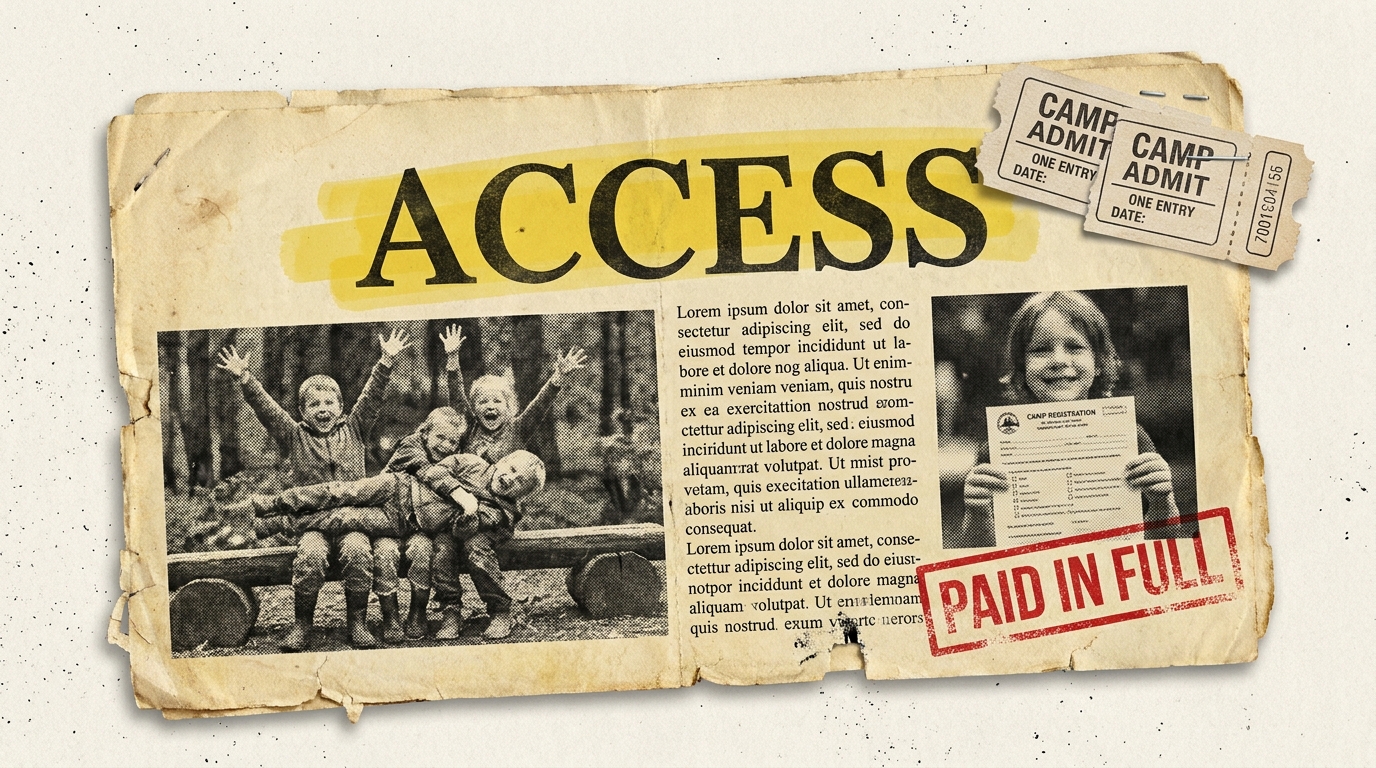
A typical US summer camp week runs about $400. A full ten-week summer for one kid often lands at $4,000 or more. Across two kids it turns into a real household budget line. Aid exists at every price tier — but most families miss it because they apply too late. Most aid deadlines close in January or February for the summer ahead.
- Four real paths to lower cost: need-based aid at private camps, city rec sliding scale, third-party scholarships, and employer benefits (including the DCFSA — which most families leave on the table).
- Mind the calendar. January and February for private camps. April and May for city programs.
- Specialty-camp aid is common and under-applied-for. STEM, music, and arts camps actively fund diversity pipelines.
- Stack the tactics. Rec programs plus a scholarship week plus a family vacation week — one summer, multiple funding sources.
- The DCFSA is effectively a 20-to-25-percent discount on day camp for kids under 13. You have to enroll during your employer's benefits window, which is usually November.
Where to look, in roughly the order they pay out.
1. Need-based aid at private camps
Most private camps with 20-plus years of history run need-based aid programs funded by alumni donations and a slice of general revenue. A typical award lands at 30-to-50 percent of tuition. The best-resourced programs live at well-known overnight camps — Interlochen, Tanglewood, the Ramah network — and at established day camps like Galileo and iD Tech. Apply by January 15 to February 28 for the summer you want. Expect to send tax returns plus a FACTS Confidential Financial Statement (a $50-to-$80 processing fee). Apply even if you think you don't qualify — aid brackets often extend further up the income ladder than families assume.
2. City and county rec programs
Every major metro runs rec-department summer camps with sliding-scale fees. Full rate usually lands at $80 to $200 a week; sliding-scale aid can reduce that to $20 to $50. Qualification usually hinges on free-and-reduced-lunch status or HUD income thresholds. Deadlines are later than private-camp aid (April or May) and quality varies by city, but the big ones are worth knowing: SF Rec and Park, LA City Rec, NYC DYCD programs, the Chicago Park District, Boston Centers for Youth and Families. Search "[your city] summer camp sliding scale" or start on your city's parks-and-rec website.
3. Third-party scholarships
Funding sources that live outside the camp itself. Five worth knowing:
- The ACA Scholarship Directory (aca.camps.org) pulls together aid from more than a hundred camps in one place.
- Send A Kid To Camp programs run by local Rotary clubs, Kiwanis chapters, and YMCAs fund specific camps in specific communities.
- NeedyMeds lists summer camps for kids with chronic illness or disability.
- Identity-based scholarships through Camp Fire, Jewish Federations (which often have camp-specific scholarship funds), NAACP youth programs, Girls Inc, the Boys and Girls Clubs, and Big Brothers Big Sisters.
- Camp-specific foundations — many named camps have private donor foundations attached. Ask the camp directly: "Do you partner with any foundations or alumni funds for aid?"
4. Employer benefits
The easiest path to deploy, and the one most families leave on the table.
- Dependent Care FSA (DCFSA). Up to $5,000 a year pre-tax for day camp for kids under 13. Not for overnight camp. Effective discount: 20-to-25 percent depending on your bracket. You have to enroll during your employer's benefits window, which is usually November.
- Employer-sponsored dependent-care subsidies. Increasingly common at larger employers — $500 to $5,000 a year, direct.
- Camp-specific partnerships. Some employers negotiate discounts with specific camps — tech employers often have a deal with iD Tech, for example.
- EAP referrals. Some Employee Assistance Programs subsidize care in specific situations. Rarely advertised.
Why April is almost always too late.
The single biggest mistake families make is applying for aid after the sticker shock lands. Private camps commit their aid pools in January and February. By March, the pool is usually exhausted. By April, you're competing over whatever scraps are left plus whatever the camp holds back for a waitlist. Knowing this ahead of time is worth real money.
A workable timeline:
- November and December: browse camps, pick the top 5 to 10 candidates, note each one's financial-aid deadline and what documents they want. Enroll in a DCFSA during your employer's benefits window (usually November).
- January: start aid applications at your priority camps. Pull together tax returns, pay stubs, and a short narrative about your family's situation.
- February: submit every aid application by February 15 to 28. Follow up with each camp to confirm receipt.
- March: aid decisions land. Accept the yes's and lock in payment plans. For the no's, pivot to third-party scholarships.
- April and May: city rec enrollment opens. Fill in the gaps with free library and community programs.
A tight-budget summer, actually.
Here's what a ten-week summer can look like for one kid, age 8, stacked together — about $725 before tax savings, versus the $4,000 or more you'd pay at full-rate day camp straight through:
| Weeks | Program | Cost |
|---|---|---|
| 1-2 | City rec day camp (sliding scale) | $100 |
| 3 | Library / museum free summer program | $0 |
| 4 | Family vacation (grandparents) | $0 |
| 5 | Scholarship week at nicer STEM camp | $150 |
| 6-7 | YMCA day camp (partial aid) | $300 |
| 8 | Boys + Girls Club (free or near-free) | $50 |
| 9 | Church-affiliated day camp | $125 |
| 10 | Home / grandparent / family visit | $0 |
| Total | $725 |
After the DCFSA's 22-percent tax savings knocks off about $160, net cost lands at $565 for ten weeks of summer coverage. The move is thinking of the summer as eight to eleven weeks you mix and match, not one camp you pick and commit to.
Questions other parents asked
How much aid do private camps typically offer?
At established private camps, need-based aid usually covers somewhere between 20 and 80 percent of tuition, with most awards landing in the 30-to-50-percent range. Overnight camps tend to have larger aid pools than day camps — they're more expensive to begin with, and they usually sit on longer-standing alumni donor bases. Some camps give nearly full scholarships to 5-to-15 percent of campers each summer. The clarifying question to ask: 'What percentage of campers received aid last summer, and what was the average award?' A camp that can't answer probably doesn't have a real aid program.
When are the aid deadlines?
Most overnight camps close financial-aid applications between January 15 and February 28 for the following summer. Waiting until April is usually too late — the aid pool is already committed and the response comes back as 'we're full on aid this year.' Day camps with aid programs have smaller pools and rolling timelines, but the same January-to-February window is still your best shot. City rec programs typically have later deadlines, April or May, because they fund through general budgets rather than a fixed pool.
What documentation do I need?
A typical private-camp aid packet wants current tax returns (1040 plus all schedules), W-2s and 1099s, a short narrative about your family's situation, and sometimes a Confidential Financial Statement run through FACTS or a similar service ($50–$80 processing fee). City rec programs usually just need proof of income (pay stubs) or free-and-reduced-lunch status. Third-party scholarships vary — some want essays, teacher recommendations, or a record of community service.
What are the main third-party scholarship sources?
Five worth knowing. The American Camp Association's scholarship directory at aca.camps.org aggregates aid from more than a hundred camps. Send A Kid To Camp programs — usually run by local Rotary clubs, Kiwanis, or YMCAs — fund specific camps in specific communities. NeedyMeds keeps listings for kids with chronic illness or disability. Identity-based scholarships live inside Camp Fire, Jewish Federations, NAACP youth programs, Girls Inc, and the Boys and Girls Clubs. And a lot of named camps have private foundations attached to them — Camp Ramah has the Ramah Financial Aid Coalition, Interlochen runs a robust scholarship pool. Ask directly: 'Do you partner with any foundations or alumni funds for aid?'
Can I use a Dependent Care FSA or HSA for summer camp?
Dependent Care FSA: yes, but only for day camps for kids under 13, up to $5,000 a year pre-tax. Overnight camps are a no — DCFSAs don't cover them, full stop. HSAs usually don't cover camps unless the camp is medically prescribed. Before you enroll in a DCFSA, confirm the camp can provide an EIN for reimbursement. For families that qualify, running camp costs through a DCFSA is effectively a 20-to-25 percent discount depending on your tax bracket — and it's one most families miss simply because the enrollment window falls months before anyone is thinking about summer.
What about employer benefits beyond the DCFSA?
Three things worth a ten-minute conversation with HR. First, an employer-sponsored dependent-care subsidy — these are increasingly common at larger employers, usually $500 to $5,000 a year. Second, tuition-discount partnerships with specific camps or camp networks (tech employers and iD Tech, for example). Third, an Employee Assistance Program referral for subsidized care. A few employers also quietly fund 'child enrichment' stipends that cover camp. None of this is on the benefits home page — you have to ask.
What's the cheapest way through a full summer?
Stack four tactics. City and county rec center programs, which usually run $80 to $200 a week with sliding-scale pricing available. YMCA and YWCA day camps, which run on a sliding scale almost everywhere. Library and museum summer programs, often free or $50–$100 a week. And community-organization camps — Boys and Girls Clubs, Salvation Army, church-affiliated camps if that's appropriate for your family. Combine across the weeks: four weeks of rec camp, a free library week, a scholarship week at a nicer camp, a family vacation week, and you can cover a summer for well under $1,500 total.
Do specialty camps (STEM, music, sports) offer aid?
More than parents assume. Specialty camps often want diversity of background on top of income diversity, and they fund aid specifically to recruit kids who are underrepresented in their discipline — girls and non-binary kids in STEM, low-income kids in elite music, first-generation students in academic summer programs. Apply even if you think your financials look marginal; diversity-focused scholarship pools often reach further up the income ladder than need-based aid does. Specialty camps with strong aid pipelines include iD Tech, Breakthrough Summer, Interlochen, and the School of American Ballet Summer Course.
What if I miss the deadlines?
Don't give up yet. Five things still work after the window closes. Ask if the camp runs a late-aid or waitlist-aid process — some camps hold a small pool back for exactly this. Ask about work-exchange: older kids (13 and up) can sometimes reduce tuition by working as a CIT or in the kitchen. Look for year-long camp operators that sell unused weeks at a partial rate in late spring. Contact the camp's alumni or parent association directly — sometimes private gifts cover emergency aid requests. And reach out to local Rotary, Kiwanis, or community foundations, which often have flexible community-benefit spending that closes fast.
How do I find aid-offering camps where I live?
Two starting points. Use the 'financial aid' feature filter on any city directory here — we tag camps that publicly offer aid. Then check the ACA's camp finder at aca.camps.org and filter for ACA-accredited camps that also offer financial aid. Cross-reference with your city rec center's listings (search '[your city] summer camp sliding scale' or '[your city] rec center summer program'). Budget two or three hours to map your local aid landscape the first summer. The work compounds — once you've done it, next summer is easy.
Where this comes from. Pricing anchors pull from published 2026 rates at camps across the US and Canada. Aid pathways are synthesized from the published aid policies at 30-plus private camps, the ACA's aid directory, the federal DCFSA rules in IRS Pub 503, and community programs in the twenty biggest US metros.
Scope. US and Canada, private and community and municipal camps. This guide doesn't cover tax credits — the Child and Dependent Care Tax Credit is a separate topic, and worth a conversation with a CPA.
Bias note. Written by a parent, reviewed by our editor. Not a tax advisor or a financial-aid specialist. Federal and state tax policy shifts year to year; confirm DCFSA rules with your own plan before you enroll.
Last reviewed. 2026-04-18. Aid deadlines and DCFSA limits change annually — verify before you apply.
Related guides
- 2026 camp pricing — what a reasonable aid request looks like
- How to choose a summer camp
- Day camp or overnight? — overnight programs tend to have the largest aid pools
- Los Angeles camp directory — compare aid notes on camp listings
- New York City camp directory — check nonprofit and city-run options first
- San Francisco Bay Area camp directory — review scholarships and sliding-scale policies
- Open the planner — stack and track a tight-budget summer
Filter for aid-eligible camps.
The planner's financial-aid filter surfaces every camp in your city that offers scholarships, sliding-scale, or sibling discounts.
Open aid-eligible camps →