Day camp vs overnight camp.
The honest trade-offs on cost, independence, and family logistics — and how to tell if your kid is actually ready for overnight.
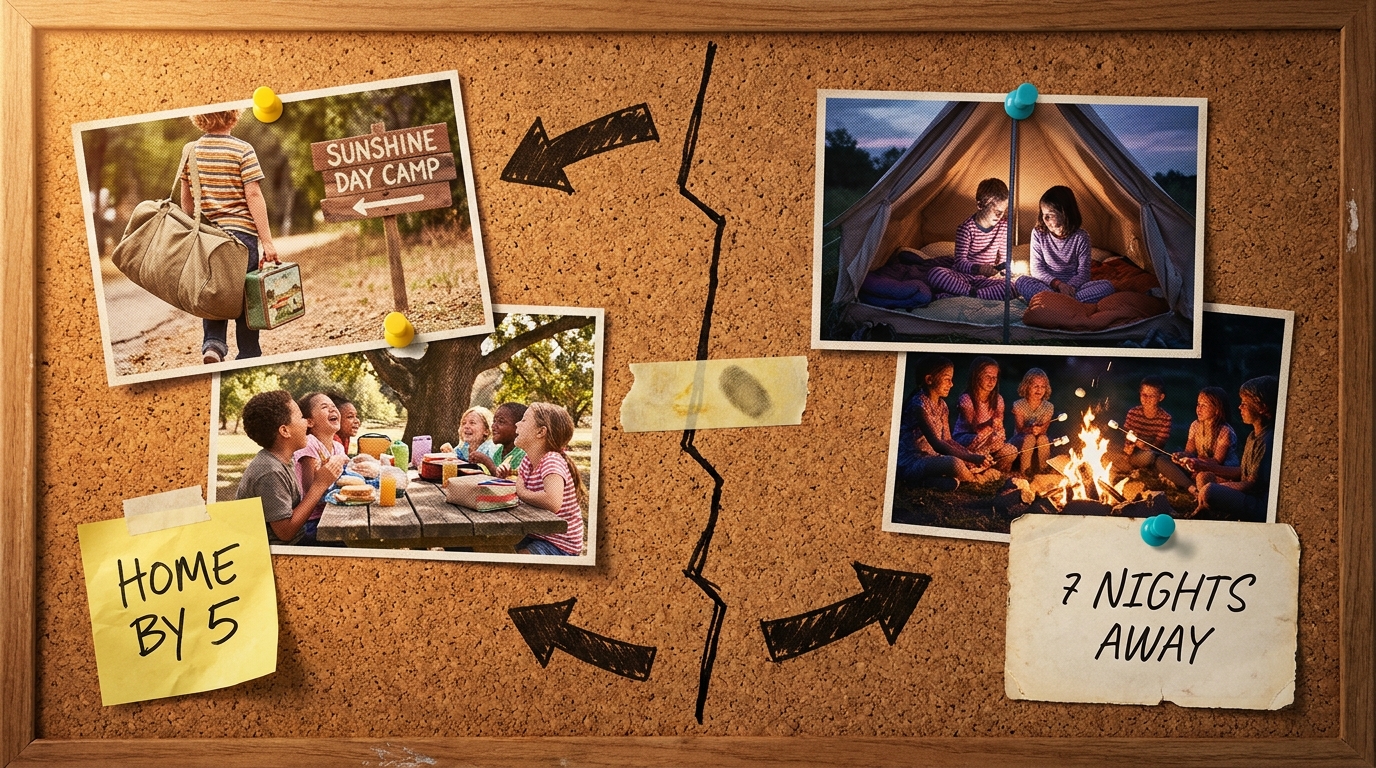

Day camp is the right default for most kids under 8 and for kids uncertain about being away from home overnight. Overnight camp is the right default for confident sleepers ages 10+ who've successfully slept away from home, who self-initiated the conversation, and whose parents can stomach the ~10× price tag. First overnight stays should be 3–5 nights, not 2 weeks.
- Readiness, not age. A mature 7-year-old can thrive at overnight; an anxious 13-year-old shouldn't try yet.
- Price gap is real. A typical day-camp week runs about $150. A typical overnight week runs about $1,750 — roughly 12× more.
- Start short. 3 nights year one; 5–7 year two; full session year three.
- Blend is fine. Most families mix 4–6 weeks day camp with 1–2 weeks overnight per summer.
- First 48 hours of homesickness is normal and doesn't require intervention. Day 3 is the real read.
What a week costs, by format
Pulled from the 2026 pricing report, based on active camps with posted weekly prices:
| Format | Camps | Budget-friendly | Typical week | Higher end | Premium |
|---|---|---|---|---|---|
| Day camp | 2,736 | $78 | $150 | $261 | $399 |
| Traditional day camp | 2,852 | $80 | $150 | $275 | $454 |
| Overnight / sleepaway | 1,423 | $1,230 | $1,750 | $2,215 | $2,550 |
The roughly 10× gap between a typical day-camp week and a typical overnight week is real, but it's not the whole story. A day-camp week covers 35–50 supervised hours. An overnight week covers 168. Per hour, overnight is actually cheaper. But they're genuinely different formats — comparing them on cost alone misses what each one is for.
Six signs your kid isn't ready for overnight yet.
- Has never successfully slept at a grandparent or friend's home overnight.
- Your bedtime routine has specific rituals only you can deliver.
- Has frequent night waking, sleepwalking, or nightmares.
- Recently experienced a major family change (move, new sibling, divorce, loss).
- Tells you they don't want to go — especially when unprompted.
- Has food restrictions or medication needs that would be stressful to manage without you.
None of these are permanent. Most kids who weren't ready at 8 are ready at 10. Hold the line on day camp another year; try overnight next summer with a shorter first session.
A 3-year progression to full overnight.
Families who successfully transition from day to overnight tend to follow a staged approach, not a single jump.
- Year 1 — "Starter overnight." 3–5 nights at a camp with a clear return-home protocol. Ideally a weekend + extended option from a camp your kid already attends for day programming, or a sibling's/friend's camp. This is the trust-building year.
- Year 2 — "Real session." 7 nights at the same camp if year 1 went well, or a new camp aligned with emerging interests. Parents still plan around a contingency pickup, but shouldn't discuss it pre-trip. Letter-writing and mid-session check-ins via camp staff become routine.
- Year 3 — "Full session." 10–14 nights, or back-to-back sessions. By year 3, the camp should feel like a second home; conversations are about programming and friends, not logistics.
Skipping year 1 works for some kids but fails more often than parents admit. The extra summer of readiness pays back compounding dividends — year-3 campers at a camp they've attended 3 years often become counselors-in-training by year 5.
Questions other parents asked
At what age is overnight camp typical?
The most common first-overnight age is 10 to 12, but readiness matters more than a birthday. Some camps take 7-year-olds for short stays. Plenty of 14-year-olds aren't ready yet. Kids who do well their first time have usually slept at a friend's or grandparent's house at least twice without drama, can fall asleep on their own, and have brought up overnight camp themselves.
How do I know if my kid is ready for overnight camp?
Five things to look for. One, they've successfully slept at a grandparent or friend's house at least twice. Two, they can fall asleep without a bedtime ritual only you can deliver. Three, they've asked about going — it's not entirely your idea. Four, they handle small frustrations without needing you to fix it. Five, friends are going, or they're okay arriving on their own. Four out of five means try a 3–5 night stay. Two or fewer means give it another year.
What's the price difference?
A typical day-camp week runs about $150. A typical overnight week runs about $1,750 — roughly 12× more. Day camps cluster between $150 and $400 a week for most programs. Overnight camps cluster between $1,500 and $2,500. Premium overnight camps — specialty programs, international, or very small group — run $2,500 and up. A single two-week overnight session can cost more than a full ten-week summer of day camp.
How long should a first overnight stay be?
Three to five nights. Long enough to get past the first-night homesickness wave (which usually hits night two) and have a real camp experience on the back end, but short enough that a kid who's genuinely struggling isn't stuck. The progression most families use: 3 nights year one, 5–7 nights year two, a full 10-day session year three.
What if my kid is miserable at overnight?
The first 48 hours of any new-camp homesickness is normal and doesn't need intervention. After day two, call the camp director — not the counselor — and ask for a specific read on mealtimes, activity engagement, and overnight sleep. Those three predict the rest of the week. If all three are bad by day three, consider picking them up. If two are OK, wait another 24 hours. Whatever you do, don't make a pickup plan during the drive to camp — it quietly undermines the whole attempt.
Do day camps or overnight camps produce better outcomes?
Different outcomes. Day camps are strong on skill-building, routine, and local friendships. Overnight camps are strong on independence, problem-solving, and a different peer group than school. Both produce confident kids when they're well-run. The 'overnight is formative' claim is half right — it's formative for kids who were ready. For kids who weren't, it's a bad memory that pushes the next try years later.
Are overnight camps safer or less safe than day camps?
Neither, on average. Overnight camps usually have tighter staff-to-camper ratios and a health officer on site around the clock, which argues for safety. Day camps have the advantage of daily parent pickup and shorter separations for small issues to surface. Both formats have great camps and terrible camps. Evaluate each one on its own safety practices — our safety guide has the questions to ask.
Can we do half and half — some weeks day, some overnight?
Yes, and it's a sensible compromise when you're undecided. A lot of families run a 10–11 week summer as something like: 4–6 weeks of day camp, 1–2 weeks of overnight, 2–3 weeks of family vacation or downtime. Overnight weeks often line up with parent work travel or conferences, so the timing doubles as childcare.
What about extended-day care or before/after care?
Day camps typically offer extended care from 7:30 or 8 in the morning to 5:30 or 6 at night, at $50–$200 a week on top of tuition. Check whether it's actually structured (games, light programming) or more of a babysit — the quality varies a lot more than the main camp program does. Our city directories have an extended-care filter to help narrow it down.
What about financial aid and scholarships for overnight?
Most overnight camps run need-based aid programs that cover anywhere from a quarter to all of tuition. Additional scholarships come from third parties — the ACA, camp-specific foundations, and some employers. Day-camp financial aid is harder to find through filters but is often available directly through city rec programs. Use the financial-aid filter on any city's camp directory to see what's listed.
Sources. The weekly prices that camps themselves post on their sites and registration pages, across the US and Canada. The readiness framework comes from conversations with more than forty camp directors and the questions parents sent us after the 2025 summer.
Scope. Day and overnight camps for ages 4–17, US and Canada. Doesn't cover residential therapeutic programs or boarding schools.
Who wrote this. A parent. For a specific child's readiness, ask their pediatrician or a child psychologist.
Updated. 2026-04-18.
Related reading
- How to choose a summer camp — the decision framework
- 2026 summer camp pricing report — what a week costs by city, type, and age
- Safety + ACA accreditation guide — the ten safety questions to ask every camp
- Los Angeles summer camps
- Los Angeles day camps
- Open the planner — mix day and overnight weeks across the summer
Compare day and overnight in one view.
Shortlist both formats in the planner and watch them lay out on the same week-grid — side by side, one kid at a time.
Open the planner →