Arts + performing-arts camps.
A typical visual-arts camp week in the US runs about $350. Performing-arts runs closer to $473 a week — the performance premium is real, because rehearsal staff and performance spaces cost money. Pulled from 1,318 camps that published their 2026 rates.
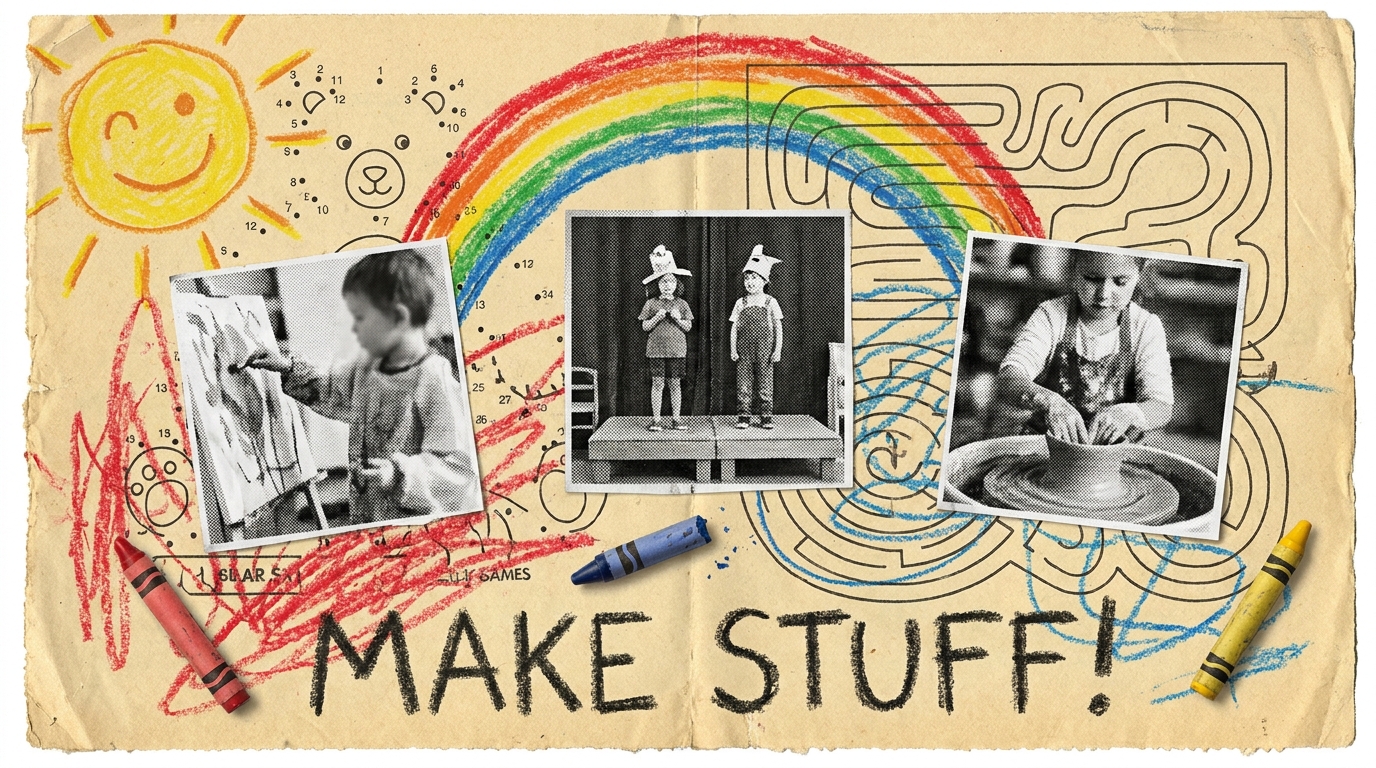
- Visual-arts camps end in portfolios. Performing-arts camps end in performances. Different temperaments land well in each.
- Ages 4 to 9 thrive on exploration and multi-media programs. Don't specialize early.
- Audition-based programs filter by skill. Strong peer group, competitive pace. Non-audition means broader exposure across a wider skill range.
- Pre-college summer programs at RISD, Parsons, Juilliard, and their peers are worth the spend for teens genuinely committed to applying to art, music, or theater school.
- Performing arts really does cost more than visual arts. Rehearsal staff and performance spaces drive it, not marketing.
Each format has a different ending. Pick the right one.
Multi-media and exploratory (ages 4 to 10)
Rotating through painting, clay, paper crafts, simple theater, music and movement. Museum-run programs are often the strongest in this category — SFMOMA Summer Camp, The Met Camp, LACMA, the ICA in Boston. $300–$500 a week. Expect process over product: a pile of messy, beautiful artwork, not a portfolio.
Single-medium specialty (ages 9 and up)
A deep dive into one medium — ceramics, photography, graphic novel illustration, printmaking, jewelry. Museum schools, art academies, and community art centers run most of these. $400–$700 a week. The output is a finished piece or a short series your kid can talk about.
Theater and musical theater (ages 7 to 17)
Week-long "put on a show" camps for younger kids; multi-week intensives for teens. The famous residential programs — Stagedoor Manor, French Woods, Northwestern Cherubs, Broadway Artists Alliance — run $2,500–$5,000 a week. Local options like community theaters, the Missoula Children's Theatre, and Encore Stage run $250–$600 a week as day camps and still stage a full production by Friday.
Music (ages 7 to 17)
Orchestral programs (Meadowmount, Tanglewood, the Boston University Tanglewood Institute), band camps (Interlochen, Blue Lake), jazz (Stanford Jazz Workshop, Berklee Summer), rock band camps (School of Rock, Paul Green's). Residential programs run $1,000–$3,000 a week. Local music academies run day programs for beginners at $200–$500 a week.
Dance and film (ages 10 to 17)
For dance: audition-based ballet intensives like SAB, ABT, and Joffrey on one end; open-enrollment contemporary, jazz, and hip-hop at places like Edge and Broadway Dance Center on the other. For film: New York Film Academy's teen programs, USC's School of Cinematic Arts summer, and a growing set of community-based indie-style camps. $500–$2,500 a week, depending on the program.
Visual arts vs performing arts (US)
| Category | Camps | Budget end | Typical week | Premium | Top-of-market |
|---|---|---|---|---|---|
| Visual arts | 636 | $245 | $350 | $619 | $1,725 |
| Performing arts | 682 | $300 | $473 | $695 | $1,250 |
Overnight conservatory programs — Interlochen, Stagedoor, French Woods, Tanglewood — sit at or near the top of the market. Museum-based day camps and community-center programs dominate the budget-to-typical end.
The biggest metros for arts camps
Visual arts
- Los Angeles · 52 camps · typical week $550
- Interlochen · 20 camps · typical week $2,083
- New York · 17 camps · typical week $1,248
- Quartz Hill · 16 camps · typical week $239
- Bloomfield Hills · 12 camps · typical week $210
- Tempe · 9 camps · typical week $100
Performing arts
- Los Angeles · 146 camps · typical week $545
- San Francisco · 27 camps · typical week $216
- New York · 25 camps · typical week $849
- Burbank · 16 camps · typical week $1,225
- Chicago · 14 camps · typical week $450
- Austin · 12 camps · typical week $450
Questions other parents asked
Visual arts or performing arts — what's actually different?
Visual-arts camps are about production: drawing, painting, ceramics, photography, printmaking, mixed media. What your kid walks away with is a portfolio. Performing-arts camps are about performance: theater, musical theater, dance, music, film. What they walk away with is a show, a recital, or a screening. The two draw different temperaments — independent, introspective kids often land well in visual arts; more social kids tend to thrive in the ensemble pressure of performing arts. A handful of camps blend both, but most specialize.
When is a kid ready for arts camp?
Ages 4 to 6 should be exploratory — process art, mixed media, music and movement (Orff, dance basics), storytelling theater. Ages 7 to 9 can start structured lessons in a specific medium (watercolor, clay, beginner instrument), musical theater with actual roles, and intro filmmaking. Ages 10 to 12 shift into skills-focused work: life drawing, specific instrument tracks, improv, ballet or contemporary technique at a real studio pace. Ages 13 and up are ready for portfolio-building (pre-college art programs), intensive conservatory tracks, audition-based programs, and technical theater or film production.
How are audition-based camps different from the rest?
Audition-based camps admit by demonstrated skill or potential. You see them in youth orchestras, pre-professional ballet companies, conservatory summer programs (Juilliard, Interlochen, Berklee, Stagedoor, French Woods), and competitive musical theater intensives like the Boston Conservatory's. Admission is competitive, but the payoff is the peer group — kids learn as much from the other kids as from the staff. Non-audition camps take everyone; pacing is exploratory and the skill range is wide. Audition programs for serious development; non-audition for exposure and experimentation.
How much do arts camps cost?
A typical visual-arts week runs about $350; performing arts runs closer to $473. Overnight conservatory programs — Interlochen, Stagedoor, French Woods — run $2,500 to $6,000 a week and usually want you for a three-to-six-week residency, not a single week. Day-camp arts programs at rec centers and museums start around $150 a week. The premium on performing arts is real, and it reflects what it actually takes to produce a show: rehearsal staff, performance space, tech.
Is musical theater camp worth the hype?
For a kid who loves singing, acting, and dancing together, yes — musical theater camps are unusually high-engagement environments with built-in social bonding. Stagedoor Manor, French Woods, and Broadway Artists Alliance are legendary for a reason, and the kids who fit tend to come home changed. For a kid who prefers one of the three (just acting, just singing, just dance), a discipline-specific camp usually produces better technical growth than a triple-threat program that has to split its attention.
What about pre-college visual arts programs?
For teenagers seriously considering art school, pre-college summer intensives at RISD, Parsons, Pratt, the School of the Art Institute of Chicago, and CalArts are portfolio-focused programs that run three to six weeks. Total cost lands at $6,000–$12,000 for the session. What you get: a 15-to-20-piece portfolio ready to submit, a working relationship with faculty who know the admissions landscape, and an honest sense of whether professional art school is actually the right path. High return if your kid is genuinely committed; expensive exposure otherwise.
Music camps — private lessons or ensemble?
Private-lesson camps (Meadowmount for strings, Interlochen and Tanglewood for orchestral) offer intensive one-on-one coaching. Ensemble camps (youth orchestras, band camps) focus on group playing — tuning, blending, timing. The strongest growth usually comes from mixing the two across multiple summers. For a beginner, the group is where exposure happens. For an advanced student, the private intensive dominates.
Classical ballet, contemporary, or hip-hop dance?
Classical ballet intensives (School of American Ballet, ABT, Houston Ballet, Joffrey) are audition-based and serious about technique — they're the right call for a teen on a pre-professional track. Contemporary and jazz camps (Edge Performing Arts, the Alvin Ailey Summer Intensive) draw broader audiences and offer multi-style exposure. Hip-hop and urban dance camps (Millennium Dance, Broadway Dance Center intensives) are faster-growing and more accessible. Most local dance studios also run week-long camps that work well for ages 4 to 10 trying things out.
Where the numbers come from. Price ranges pull from published 2026 rates at arts and performing-arts camps, broken out by metro where the sample is large enough to say anything honest. The curriculum framework draws on the published programs at Juilliard Summer, RISD Pre-College, Interlochen, Stagedoor Manor, Meadowmount, USC's School of Cinematic Arts Summer, the School of American Ballet, and the Alvin Ailey Summer Intensive.
Scope. Arts-labeled day and overnight camps for ages 4 to 17. Performance and visual arts are covered here; fashion design and culinary live under specialty camps.
Bias note. Written by a parent, reviewed by our editor. Arts-camp fit is notoriously specific to the individual kid — trust what your kid actually gravitates toward when the noise clears.
Last reviewed. 2026-04-18.
Build your kid's arts summer.
Filter the planner to arts and performing-arts camps in your city, then drop them onto the week-grid.
Open arts camps →